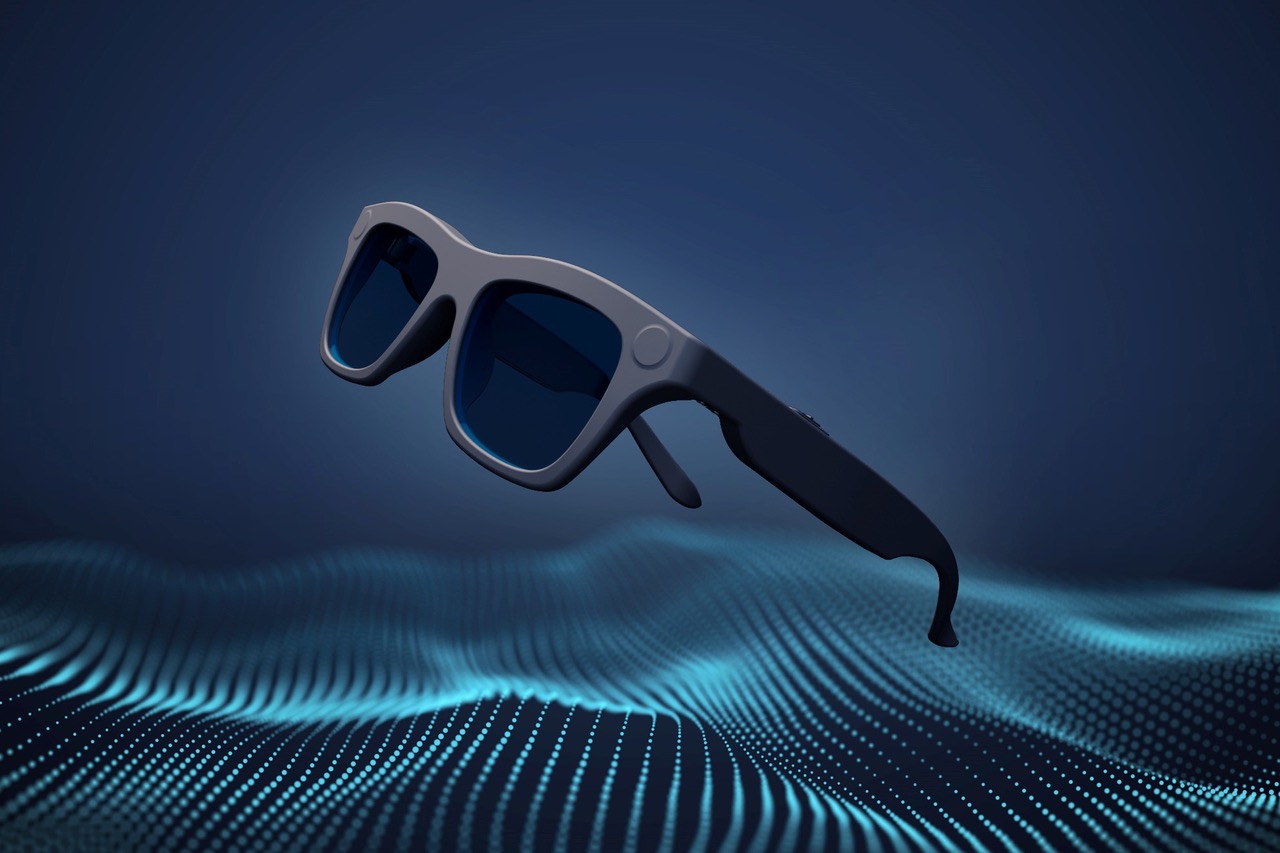
For the more than 250 million people worldwide living with severe visual impairment, audio is not a feature—it is the primary interface through which they perceive and navigate the world. iVisionTech recognised this when designing the iSEE smart glasses: an assistive platform that uses real-time obstacle detection, object recognition, and spatial mapping to guide users independently through complex environments. The challenge was not the sensing technology. It was the audio.
The Challenge
Designing assistive eyewear for visually impaired users requires more than simply adding sensors—it demands a seamless, intuitive way to translate environmental data into usable feedback without compromising safety. For iSEE, this meant solving four interconnected problems simultaneously.
First, the audio system had to deliver clear navigation cues across widely varying acoustic environments—from quiet indoor corridors to busy urban streets—without clipping, distortion, or loss of intelligibility. Second, and critically for user safety, it had to preserve full ambient awareness: any solution that blocked or masked surrounding sounds would undermine the very independence the device was designed to provide. Third, the speaker technology needed to integrate into a compact eyewear form factor without adding meaningful bulk or weight. Finally, for a device worn throughout the day, power efficiency was non-negotiable.
Traditional microspeakers fell short on nearly every count: too large, power-hungry, or unable to reproduce the speech clarity required for reliable guidance in dynamic conditions.
The USound Solution
iVisionTech selected USound’s MEMS speaker technology, purpose-built for compact, open-fit wearable applications. The integration addresses each design requirement directly.
- Open Acoustic Design: USound’s module for audio glasses delivers audio without sealing the ear canal, allowing users to perceive ambient sounds—traffic, voices, environmental cues—simultaneously with device guidance. In assistive navigation, this open-ear architecture is not a convenience; it is a safety requirement.
- Directional Sound Delivery: MEMS speakers enable targeted sound radiation towards the ear, improving clarity while minimising acoustic leakage. This ensures that critical navigation cues remain private and intelligible without increasing overall sound pressure levels.
- High Speech Intelligibility: Precision-engineered MEMS drivers are optimised for the frequency range most critical to speech. Navigation prompts, object descriptions, and proximity alerts remain sharp, distortion-free, and reliable even in noisy outdoor environments—prioritising functional clarity over media-style playback.
- Ultra-Compact Integration: The extremely thin form factor of USound’s MEMS speakers gives iVisionTech meaningful design freedom within the glasses frame—enabling the integration of larger batteries, more capable processors, and enhanced imaging modules without increasing the device’s weight or profile.
- Power-Efficient Architecture: The inherently efficient MEMS design supports low power consumption, enabling reliable all-day operation—an essential requirement for wearable assistive devices.
Impact
By integrating USound MEMS audio, the iSEE glasses transform complex environmental data into intuitive, real-time acoustic feedback. Users receive continuous spatial guidance while simultaneously perceiving their surroundings—the combination that makes truly independent navigation possible.
The result is a device that delivers:
- Improved spatial awareness through continuous, intelligible audio guidance
- Safe navigation with simultaneous perception of ambient sounds
- Natural, adaptive interaction—audio cues that respond to the user’s environment and preferences
- Comfortable all-day wear, enabled by a lightweight, unobtrusive design
Why MEMS Audio Is the Enabling Technology
Assistive devices demand a balance between performance, safety, and usability that few component technologies can satisfy simultaneously. In the iSEE application, MEMS audio is not simply a speaker—it is the interface between the user and the world.
USound’s MEMS platform offers precise, directional, and efficient sound delivery optimised for speech-based interaction; open-ear acoustics that preserve situational awareness; and a form factor small enough to disappear into stylish eyewear. Combined with semiconductor-grade manufacturing consistency and scalability, MEMS enables a reliable transition from prototype to high-volume production.
These properties—individually valuable, collectively unique—make MEMS the foundational audio technology for next-generation assistive wearables.
Learn more about iVisionTech
Learn more about iSEE.
Get started!
Evaluating MEMS speakers for audio glasses or open-ear designs? USound partners with you from first prototype to volume production.