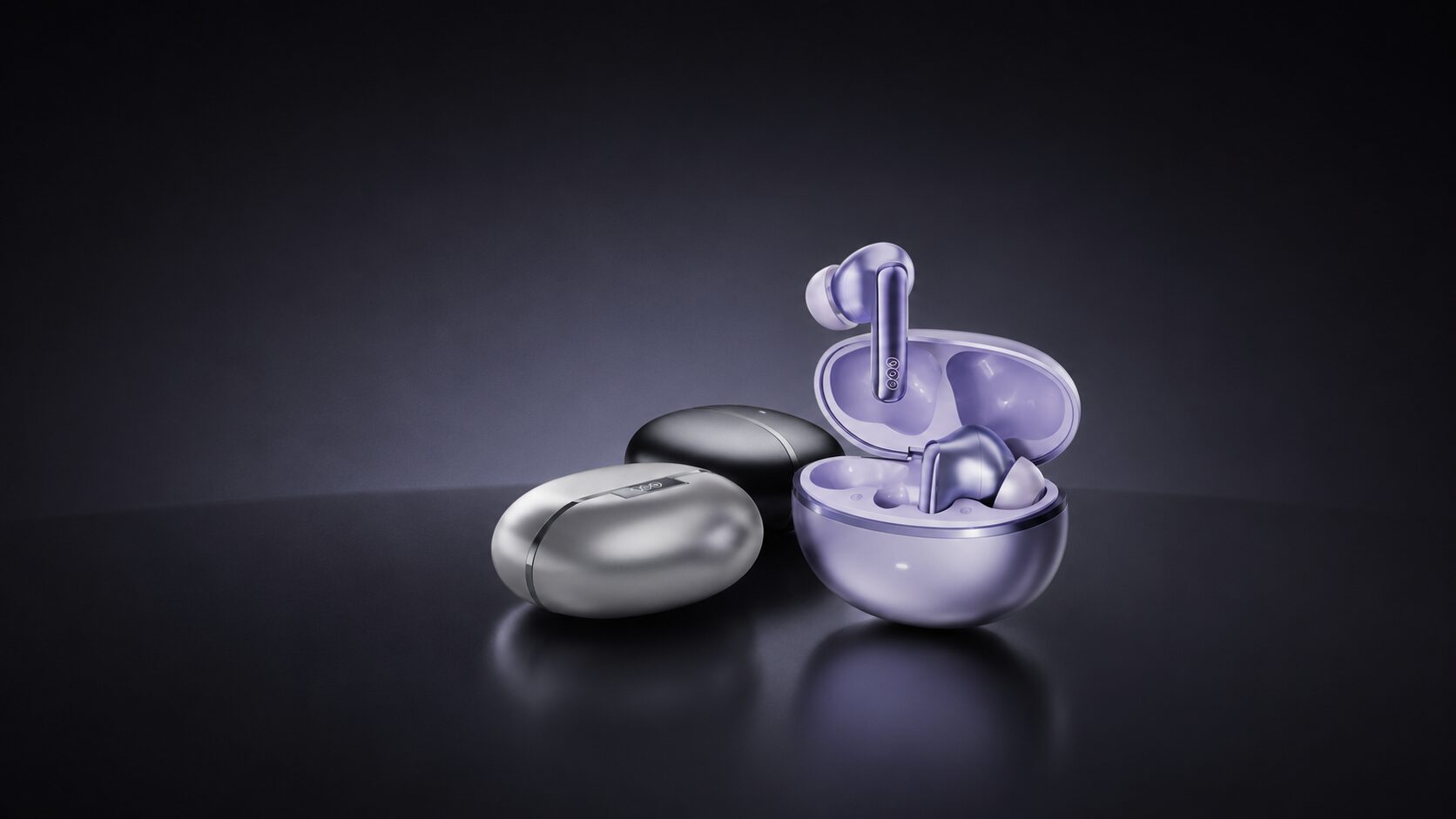
QCY’s MeloBuds N70 demonstrates how a hybrid acoustic architecture can compress Hi-Res audio performance into a compact True Wireless Stereo form factor without relying on oversized legacy driver assemblies.
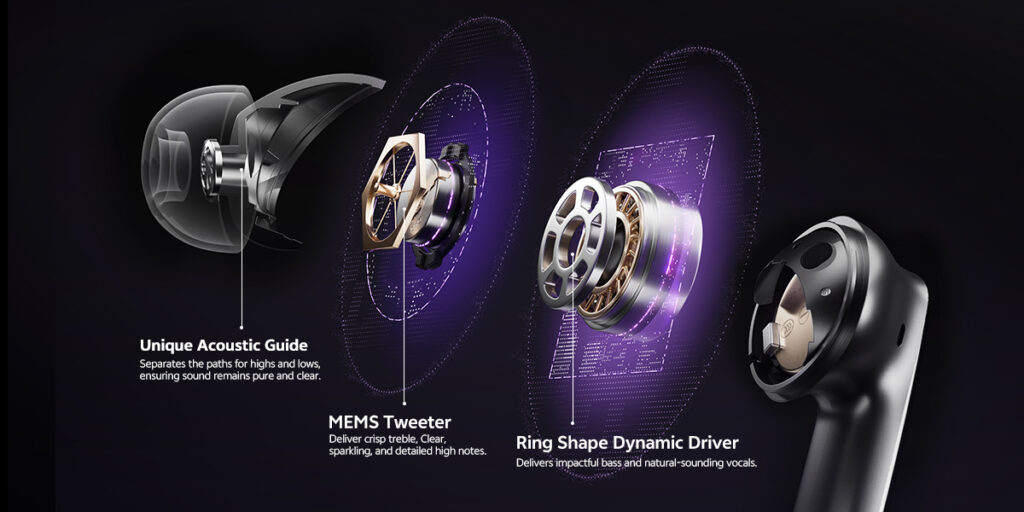
By integrating the USound Conamara MEMS tweeter with the Obo Pro. 2 ring-shaped dynamic driver, QCY created a DualCore Acoustic System that separates low-frequency excursion from high-frequency precision. The result is a production-ready earbud platform engineered for extended treble response, reduced acoustic variance, and more efficient use of housing volume.
The Engineering Roadblock
TWS acoustic design is increasingly constrained by the conflict between enclosure miniaturization, battery allocation, ANC hardware, and consumer demand for Hi-Res sound.
Conventional dynamic drivers have limitations when a single driver is expected to reproduce bass energy and ultra-high-frequency detail in a compact, sealed earbud.
The most relevant OEM bottlenecks are high-frequency roll-off above 10 kHz, unit-to-unit acoustic variance from coil and diaphragm assembly tolerances, and limited internal volume for adding a second conventional transducer. These constraints become more severe when the same housing must also accommodate microphones, DSP, battery, antennas, charging contacts, and ANC venting.
Shifting to Silicon: The Solution
QCY shifted the high-frequency section of the acoustic system to USound’s Conamara MEMS tweeter, using it as the dedicated treble driver within a hybrid two-way architecture.
The Obo Pro.2 ring-shaped dynamic driver manages controlled bass reproduction, while the MEMS tweeter handles mid-to-high-frequency detail and Hi-Res extension. QCY describes the MeloBuds N70 as using a DualCore Acoustic System that combines a ring-shaped dynamic driver with a MEMS tweeter for distortion-free sound reproduction.
From an assembly perspective, the MEMS tweeter introduces semiconductor-grade dimensional consistency into the acoustic stack. This reduces dependence on manually variable speaker construction and provides OEMs with a more repeatable transducer element for large-scale TWS production.
Proven Performance Metrics
The QCY MeloBuds N70 sets a new benchmark in TWS audio, merging Hi-Res sound with adaptive noise cancellation and ergonomic comfort.
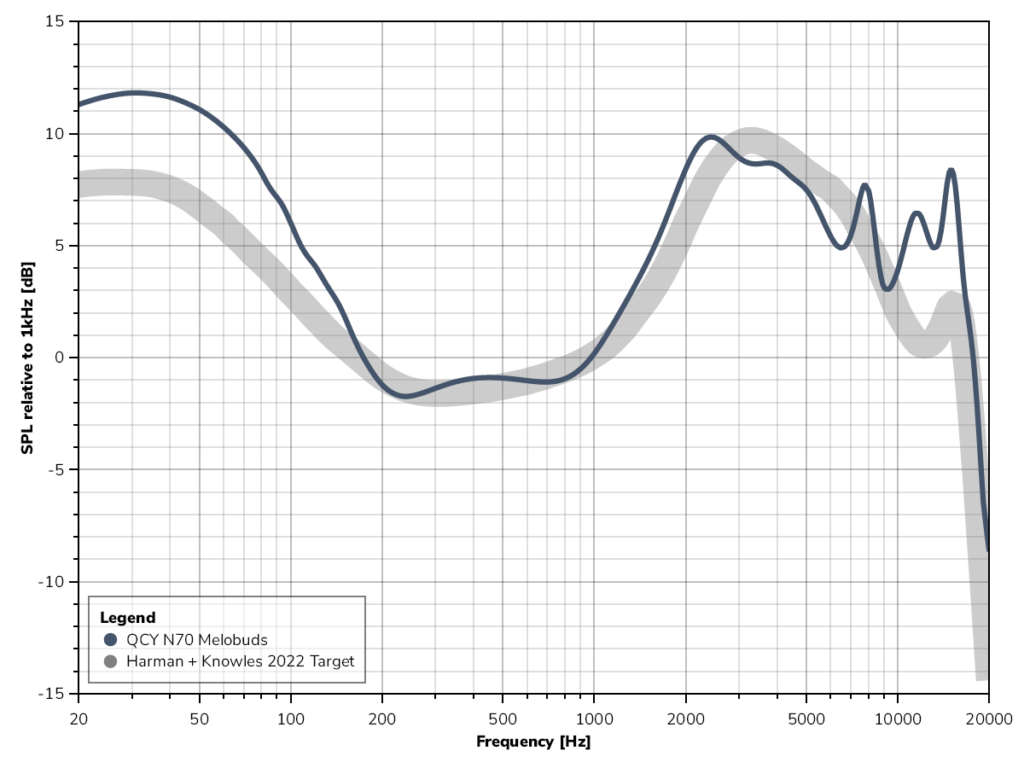
The performance of the QCY was benchmarked against the Harman target curve, refined by Knowles in 2022, to capture the treble region above 10 kHz better.
Thanks to USound’s Conamara tweeter, MeloBuds N70 extends brilliance even further, providing airy treble rarely achieved in earbuds. For listeners who prefer a softer signature, the QCY App offers a custom EQ to tailor the high frequencies.
Besides the high treble region, the QCY MeloBuds N70 closely follow the target curve. The additional level of bass below 200 Hz was a deliberate deviation. Recognizing that bass preference of the listener varies widely—from a subtle boost to over 12 dB—the design delivers additional bass while maintaining clarity. With the steep increase in SPL confined strictly to the sub-200 Hz range, the QCY MeloBuds N70 avoids muddiness and instead offers a deep, enveloping foundation that enhances the overall listening experience.
| Metric | QCY MeloBuds N70 |
|---|---|
| Acoustic Architecture | DualCore Acoustic System |
| High-Frequency Driver | USound Conamara MEMS tweeter |
| Low-Frequency Driver | Obo Pro.2 ring-shaped dynamic driver |
| Frequency Extension | Hi-Res level performance up to 40 kHz+ |
| Target Curve Reference | Benchmarked against the Harman target curve, refined by Knowles for improved treble-region evaluation above 10 kHz |
| Bass Tuning | Deliberate SPL increase below 200 Hz to support deeper bass without broad midrange masking |
| ANC Capability | Adaptive Hybrid Active Noise Cancelling; QCY product page specifies up to -56 dB noise cancelling |
| Battery Life | QCY lists 7 h / 10 h single playback with ANC on/off and 35 h / 50 h total battery life with ANC on/off |
| Connectivity / Codec Positioning | LDAC and Hi-Res Wireless Certified positioning on QCY product page |
| Manufacturing Relevance | Semiconductor-grade MEMS precision supports low distortion, high consistency, reduced housing volume, and lower power consumption claims |
Impact
- Scalability and Reliability – MEMS consistency and precision allow seamless integration into high-volume manufacturing.
- Future-Proof Design – MEMS technology positions TWS products for Hi-Res certification and enables next-generation intelligent audio features.
With Conamara MEMS Speakers, USound empowers brands like QCY to redefine consumer expectations of earbuds—delivering Hi-Res performance at scale and paving the way for the next era of intelligent audio.