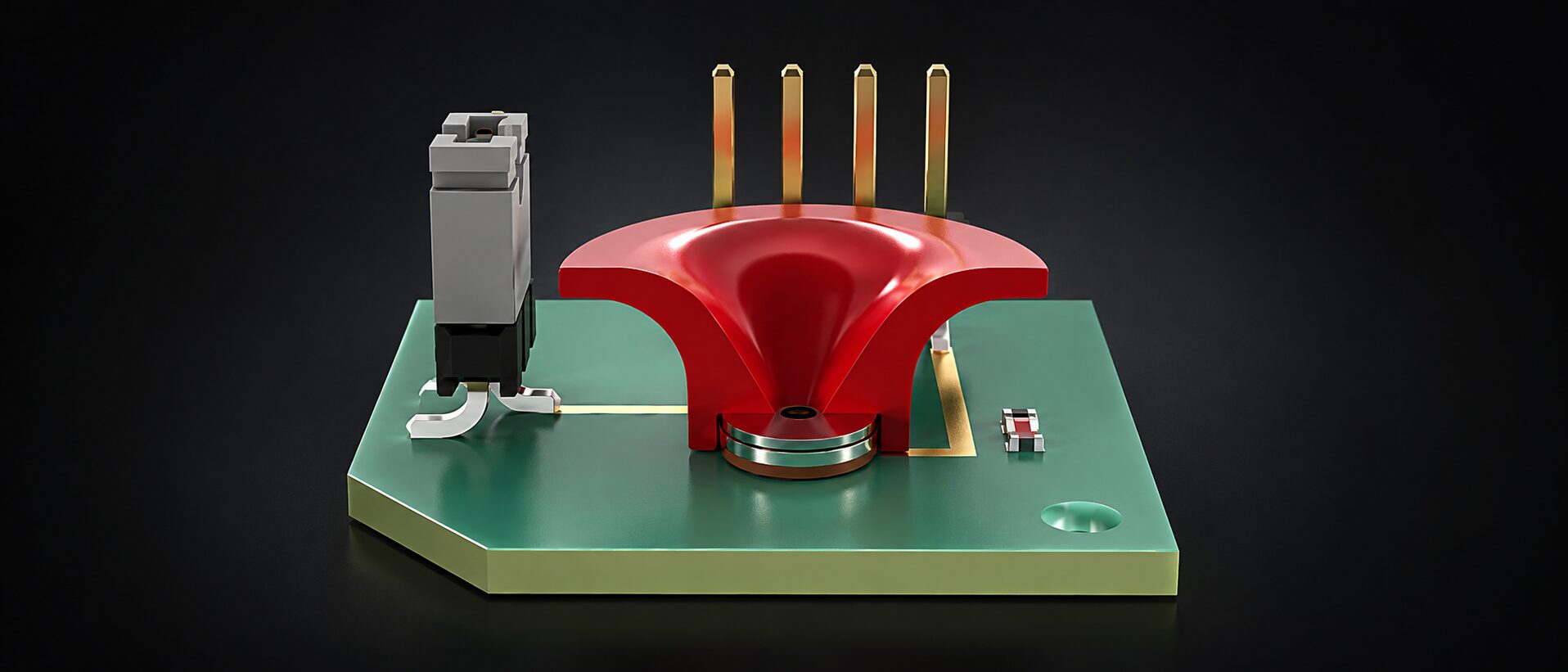
The performance of any loudspeaker or ultrasonic transducer is ultimately measured by how effectively it converts electrical input into usable acoustic output. For optimizing this energy conversion step, it is worth taking a closer look at two (closely related) aspects: acoustic loading and radiation directivity.
The efficiency of a loudspeaker is largely influenced by the acoustic loading on the diaphragm, which affects how effectively it couples to the surrounding air. Figuratively speaking, a loudspeaker’s (relatively rigid) diaphragm faces the challenge of having to transfer its own vibrational energy onto the small portion of (both very light and highly compressible) air right in front of it for it to further spread from there. Due to this mismatch between the specific impedances of the diaphragm and the surrounding air, much of the transmitted kinetic energy is merely converted into a local compression of the air in front of the diaphragm and eventually dissipates instead of being radiated in the form of sound. This results in low efficiency (typically far less than 1% for small loudspeakers!) and, therefore, low sound output.
Similarly relevant is the directivity of the radiated energy: Some portion of the emitted sound may propagate into directions where it is not required (and maybe not even wanted, think of reflections), resulting in wasted energy. For some applications, such as concert sound systems, a more uniform radiation pattern across a wide angle and a broad frequency range is desired to ensure even coverage and a consistent frequency balance. In contrast, however, some applications, such as Acoustic Localization Positioning Systems (ALPS), benefit from more focused beams, concentrating the sound to where it is actually required and thereby improving the system’s range and reducing its cost.
Both acoustic loading and radiation directivity can be addressed by incorporating acoustic horns or waveguides.
Terminology: Horns and Waveguides
The (sometimes interchangeably used) terms horn and waveguide describe two closely related concepts, both referring to acoustic structures determining how sound energy is radiated from a source:
- A horn, on one hand, expanding gradually from a narrow throat at the diaphragm to a wider mouth at the outlet, is used to transform the high-pressure/low-velocity motion of the diaphragm into the low-pressure/high-velocity air flow characteristic of sound transmission in free air; this gradual transition increases the acoustic load on the speaker, thereby enhancing its efficiency and net output.
- A waveguide, on the other hand, although similar in its basic expanding shape, is typically smaller and primarily designed to shape directivity.
From Theory to Practice
So, how can these concepts be used to enhance a loudspeaker’s performance? Let us take a look at the basic parameters defining these structures and how they influence the acoustic performance:
- Throat diameter: Should match the loudspeaker’s outlet diameter (typically the diaphragm diameter) as closely as possible to avoid any reflections.
- Horn/waveguide length: Determines how effectively the diaphragm and surrounding air impedances can be matched; typically, longer horns yield better efficiency.
- Flare profile: Describes how quickly the cross-sectional area changes from the throat to the mouth. Various shapes (conical, exponential, hyperbolic, etc.) have been developed over the decades, each offering different trade-offs regarding bandwidth, efficiency, and directivity control. Together with the length, it determines the resulting frequency response.
- Mouth diameter: Determined by the other three parameters. The larger it is, the lower the frequency at which the directivity can be shaped.
The relationships described above represent only a simplified overview. As is often the case in the field of acoustics, the actual relationships are far more complex, and tools such as finite element modeling are required to make a concrete assessment and to optimize a certain design.
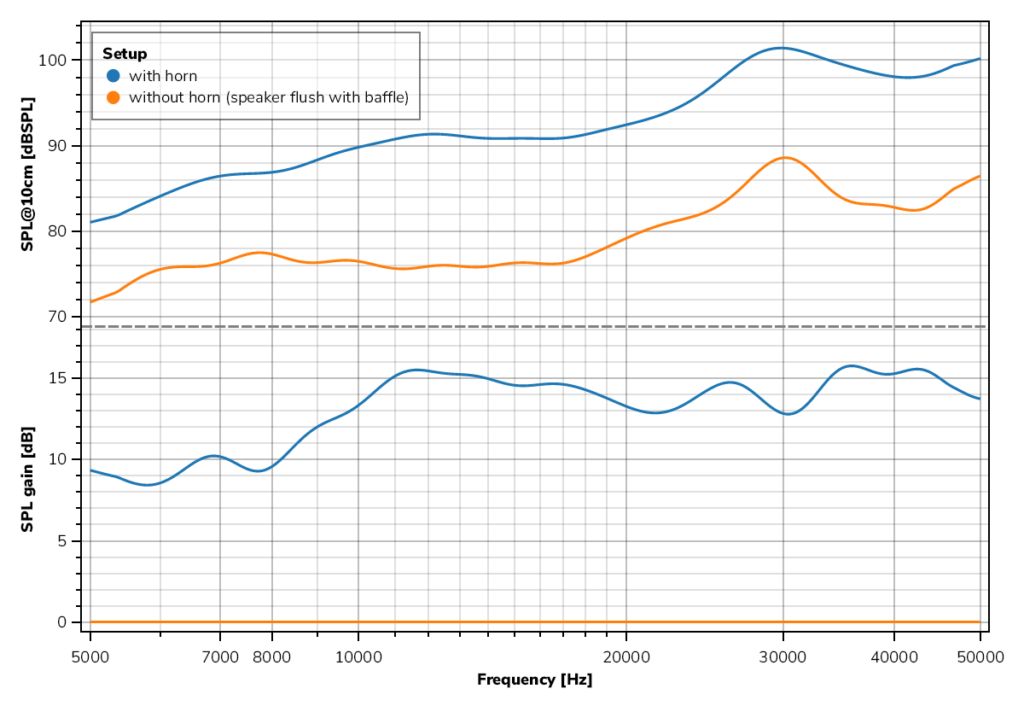
The following example illustrates the outcome of such an optimization (for a target frequency range of 5–50 kHz) using USound’s broadband ultrasound-capable Conamara UA-C0504-3T, measured in a baffle setup: When equipped with an optimized horn, the resulting system exhibits a broadband increase in sound pressure level of more than 8 dB, with the maximum gain reaching almost 15 dB:
Additionally, let us now examine the off-axis behavior to see how the horn affects directivity. Displayed below are the frequency responses for three additional angles:
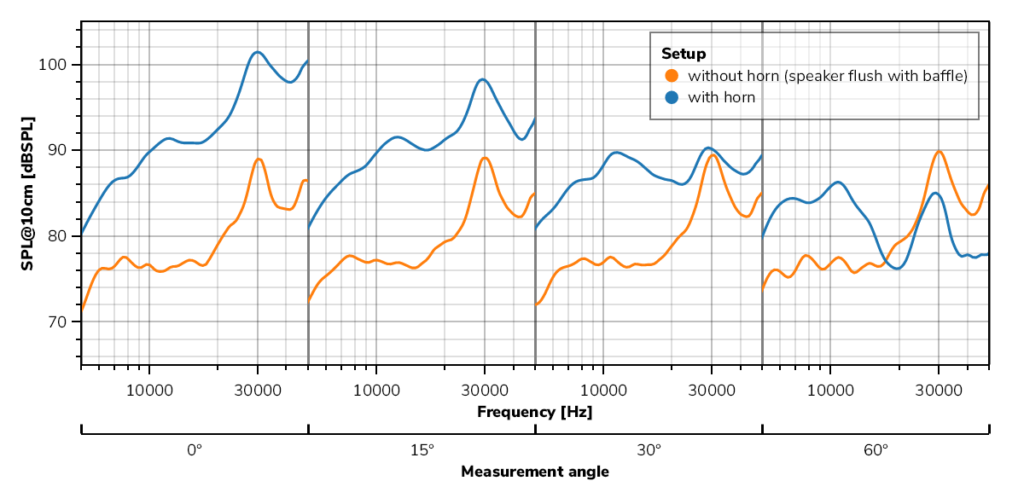
Several aspects can be observed:
- Without a horn, the Conamara UA-C0504-3T radiates sound omnidirectionally, even up to 50 kHz. This is because its outlet port is small relative to the ultrasound’s wavelength.
- With the horn attached, radiation becomes significantly more focused.
- The off-axis SPL drop depends on frequency. At 5 kHz, the horn still radiates almost omnidirectionally (the sound’s wavelength is long enough for the waves to bend around the horn). As frequency rises, however, the output becomes highly angle dependent. At a 60° angle, shading from the horn geometry causes a pronounced SPL drop at high frequencies. The increase in directionality is frequency-dependent.
Engineering the Perfect Fit
The example presented above is only one of the many things that can be achieved by shaping acoustic radiation with horns or waveguides. In practice, each application introduces its own requirements, whether targeting specific frequency bands, covering certain areas of a room, or meeting geometric constraints. Some use cases even benefit from combining multiple loudspeakers into a single horn structure. Therefore, the optimal design depends highly on the particular constraints of the application. Our engineers are available to support the development of the best individual fit.
Conclusion
Horns and waveguides offer an effective means to improve the efficiency of acoustic systems by enhancing both acoustic loading and directivity control. As demonstrated, they can yield substantial SPL gains across a wide frequency range. With requirements varying widely from application to application, creating an individually optimized design is essential.

About the author
Christian Bachleitner-Hofmann is an Acoustic Engineer at USound. Initially graduating from Vienna University of Technology in Mechanical Engineering, he brings extensive product development experience and now focuses on acoustic simulation, testing, and prototype development.