This article references an independent teardown originally published by 52audio / 我爱音频网.
In a previous USound article, we explored why two-way driver architectures are becoming increasingly relevant for modern TWS earphones. The basic principle is clear: as earbuds become smaller and more capable, acoustic systems need to do more within tighter mechanical limits.
The QCY MeloBuds N70 provides a useful real-world example of that principle in a commercial product. It integrates a USound MEMS speaker into a hybrid TWS acoustic architecture, pairing MEMS-based high-frequency reproduction with a conventional dynamic driver for low-frequency output.
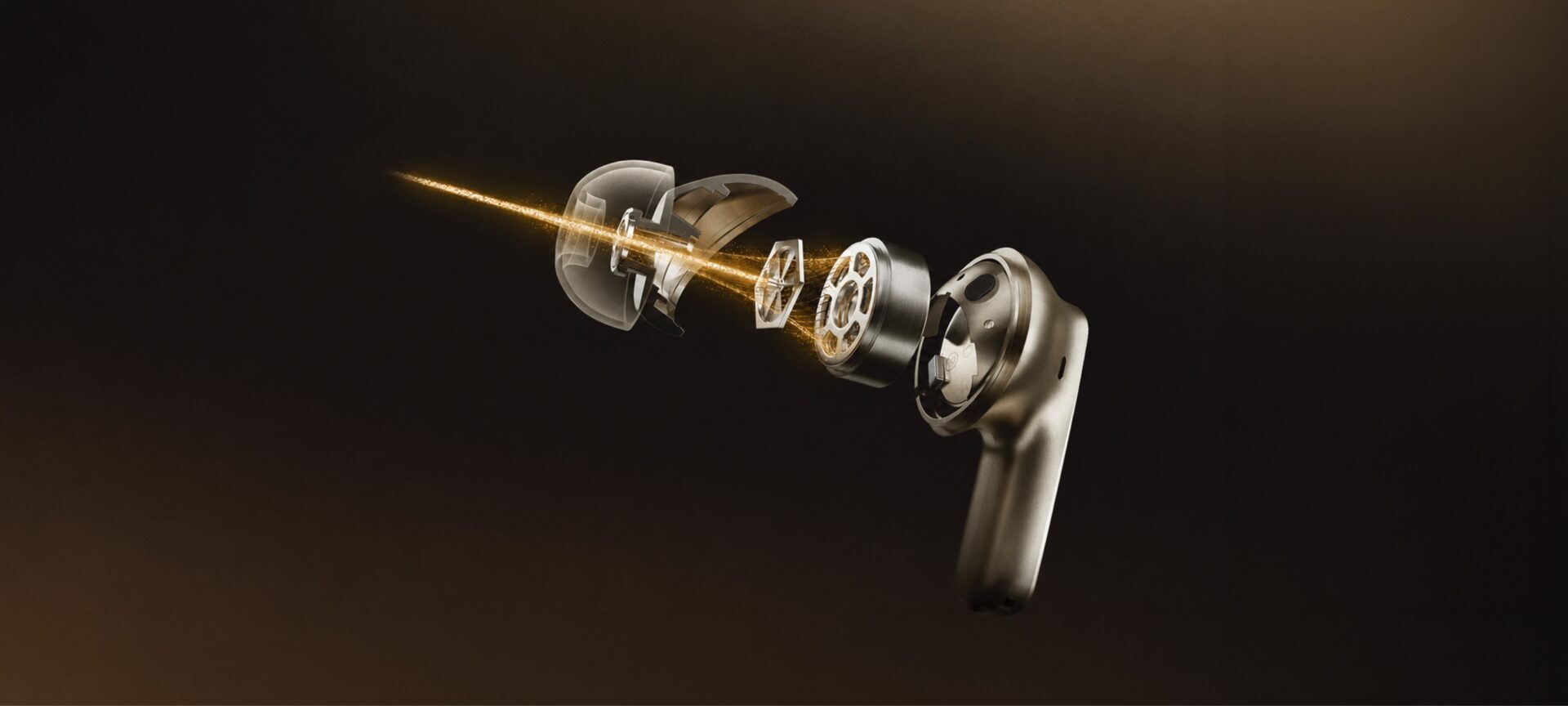
An independent teardown by 52audio / 我爱音频网 provides a detailed look at how this architecture is implemented inside the product. The teardown documents a compact coaxial dual-driver module, a dynamic driver, a dual sound-tube acoustic structure, and the USound UC-P3010 ASIC linear audio amplifier, which is designed to drive USound MEMS speakers.
This article focuses on those implementation details. It does not reproduce the teardown or repeat the general case for two-way driver design. Instead, it examines what the teardown reveals about integrating MEMS speaker technology into a real TWS earbud.
From acoustic concept to product implementation
Two-way driver architectures are often discussed at the system level: one driver supports low-frequency output, while another driver supports high-frequency reproduction. In practice, however, the challenge is not only choosing the right transducers. The challenge is integrating them into a compact product with limited acoustic volume, limited PCB area, strict battery constraints, and demanding industrial design requirements.
The QCY MeloBuds N70 is relevant because it shows this integration in a real device.
The product uses a USound MEMS speaker as part of a compact coaxial dual-driver module. The MEMS speaker is paired with a dynamic driver, allowing the system to divide acoustic responsibilities between two different transducer technologies. The teardown shows how this hybrid module is arranged inside the earbud, together with the surrounding acoustic and electronic components.
That distinction matters. The value is not only that a MEMS speaker is present. The value lies in the speaker being integrated into a complete TWS architecture.
The MEMS speaker inside the acoustic module
In the MeloBuds N70, the USound MEMS speaker serves as the high-frequency element in the hybrid acoustic system. This is a practical use case for MEMS speaker technology in TWS products.
High-frequency reproduction benefits from precision, fast transient behavior, and compact integration. These are areas where MEMS speakers are especially relevant. At the same time, the dynamic driver continues to support the low-frequency range, where diaphragm area and excursion remain important for bass performance.
This type of architecture allows product engineers to use each driver where it makes the most sense. Instead of treating MEMS speakers as a direct one-to-one replacement for every conventional driver, the design applies MEMS technology where it can add clear acoustic value within the system.
For TWS manufacturers, this is a realistic path to adoption. MEMS speakers can be introduced into hybrid designs without requiring the entire acoustic architecture to become MEMS-only from the start.
Why the dual sound-tube structure matters
One of the most important implementation details documented by 52audio is the dual sound-tube structure. The teardown shows distinct sound outlets for the MEMS speaker and the dynamic driver, helping to separate the high- and low-frequency acoustic paths before they reach the ear canal.
This is a significant detail because driver selection alone does not define sound quality. The acoustic path is just as important.
In a hybrid TWS design, two drivers must operate within a very small shared enclosure. Without careful acoustic management, the outputs of the drivers can interact in ways that affect frequency response, clarity, phase behavior, and perceived coherence.
The dual sound-tube structure is therefore not just a mechanical detail. It is part of the acoustic strategy. It helps guide each driver’s output along a defined path, supporting cleaner integration between the MEMS speaker and the dynamic driver.
For engineers evaluating MEMS speaker integration, this is one of the most useful insights from the teardown: the surrounding acoustic design must be developed together with the transducer system.
What the teardown shows about MEMS readiness
Each earbud design has different acoustic targets, cost requirements, battery constraints, and industrial design priorities. The discussion around MEMS speakers often focuses on future potential. The MeloBuds N70 demonstrates practical implementation: a hybrid acoustic module, separate acoustic paths, and dedicated MEMS driving electronics, all inside a commercial earbud.
For OEMs, this points to a clear direction. MEMS speakers can be used not only as a new component but as part of a broader acoustic architecture for compact audio products.
A practical example of MEMS speaker adoption
The QCY MeloBuds N70 offers a concrete example of how MEMS speaker technology is being adopted in TWS earphones today. It does not replace the need for careful acoustic engineering. It makes engineering more flexible.
By combining a USound MEMS speaker with a dynamic driver, a dual-sound-tube structure, and dedicated MEMS amplification, the product demonstrates one way to build a compact hybrid acoustic system for modern earbuds.
This is where MEMS speaker technology becomes most valuable: not as a drop-in replacement for conventional drivers, but as a way to enable new acoustic architectures in increasingly compact audio products.
Source note
This article references an independent teardown originally published by 52audio / 我爱音频网. The teardown documents the product’s internal architecture, including the coaxial dual-driver module, dual sound-tube structure, and USound UC-P3010 ASIC linear audio amplifier.